
How to add and subtract fractions
Find a common denominator, combine the numerators and simplify. Follow worked fraction and mixed-number examples without rounding.
By Calcr · Updated
To add or subtract fractions, first express them in equal-sized parts. Once the denominators match, combine the numerators and keep the common denominator. Simplify the result after the operation.
Find a common denominator
For 2/5 + 1/6, the smallest positive common denominator is 30. Multiply 2/5 by 6/6 to get 12/30, and multiply 1/6 by 5/5 to get 5/30. The value of each fraction stays the same because multiplying by a number divided by itself multiplies by one.
Now add: 12/30 + 5/30 = 17/30. Adding denominators would give a different quantity, so 3/11 is not the sum.
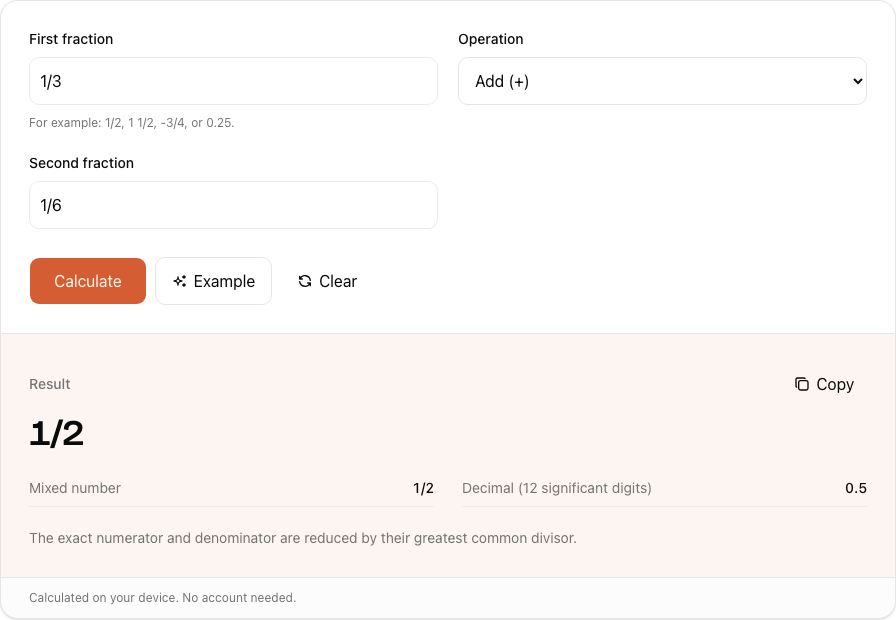
Try the example in the fraction calculator, which keeps the result exact rather than converting each input to a rounded decimal.
Subtraction follows the same method
For 7/8 - 1/3, use a denominator of 24. The equivalent fractions are 21/24 and 8/24. Subtracting their numerators gives 13/24.
The first numerator can be smaller. For 1/4 - 2/3, calculate 3/12 - 8/12 = -5/12. A negative result is valid; it means more was subtracted than the starting amount.
Convert mixed numbers before combining
A mixed number represents a whole amount plus a fraction. Convert 1 3/4 to (1 * 4 + 3) / 4 = 7/4.
Then 1 3/4 - 2/3 becomes 7/4 - 2/3 = 21/12 - 8/12 = 13/12, or 1 1/12. A negative mixed number such as -1 3/4 means -7/4, with the negative sign applying to the whole value.
Simplify and check the result
If the numerator and denominator share a common factor, divide both by it. For example, 5/12 + 1/12 = 6/12 = 1/2. A quick magnitude check helps: adding two positive fractions must produce a value larger than either input.
FAQ
Must I use the smallest common denominator?
No. Any common denominator works. The smallest usually keeps the arithmetic shorter.
Can a denominator be zero?
No. Division by zero is undefined.
Why keep an exact fraction?
Some fractions repeat as decimals. Keeping 1/3 exact avoids replacing it with an approximation before the next calculation.
For reliable fraction addition and subtraction, match the denominator, combine the numerators and reduce. Use decimal output only when an approximation is useful for the task.
For the common-denominator method, see OpenStax: adding and subtracting unlike fractions. The worked examples here use separate values.