
How to calculate percentage change
Use the original value as the base for percentage change. Work through increases, decreases, reverse changes and percentage points.
By Calcr · Updated
Percentage change measures a difference relative to the original value. To calculate it, subtract the original value from the new value, divide by the original, then multiply by 100. The denominator answers the essential question: compared with what?
Calculate percentage change in three steps
Suppose a weekly count rises from 48 to 60.
- Find the difference: 60 - 48 = 12.
- Divide by the original count: 12 / 48 = 0.25.
- Convert to percent: 0.25 * 100 = 25%.
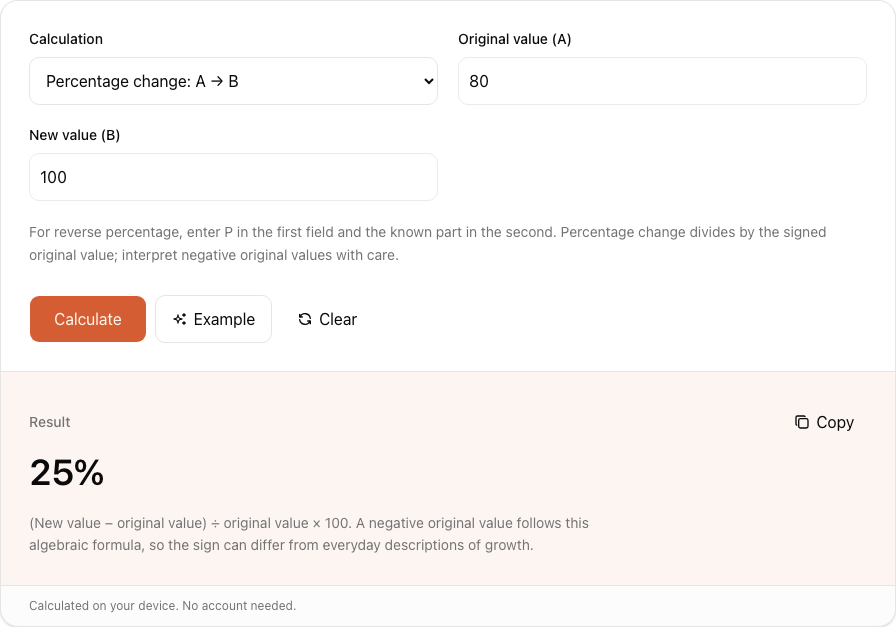
In the percentage calculator, choose change, enter 48 as the original value and 60 as the new value. A positive answer indicates an increase for this positive starting value.
Why reversing the values changes the answer
Return from 60 to 48 and the difference becomes -12. The base is now 60, so -12 / 60 * 100 = -20%. The decrease is smaller in percentage terms because it is measured against a larger amount.
This also explains why equal percentage increases and decreases do not cancel. An amount of 200 reduced by 15% becomes 170. Increasing 170 by 15% gives 195.5. Recovering 200 requires an increase of 30 / 170 * 100, approximately 17.6471%.
Percentage points answer a different question
A rate moving from 12% to 15% rises by 3 percentage points. Its relative percentage change is (15 - 12) / 12 * 100 = 25%. Use percentage points to state the direct gap between rates; use percentage change to state the relative increase.
Handle zero and negative starting values carefully
From zero to a positive amount, the formula divides by zero and has no defined percentage change. State the absolute change instead. With negative starting values, the sign can conflict with ordinary language about improvement or growth. Give the original and new values alongside any computed percentage.
FAQ
Do I divide by the old or the new value?
The old value. Dividing by the new value answers a different comparison.
Can an increase exceed 100%?
Yes. A rise from 20 to 50 is 150% because the increase of 30 is 1.5 times the original.
How should I round the answer?
Retain precision through the division and round at the end. Two decimal places may be enough for a simple report; the appropriate precision depends on the data.
Use the original value consistently, and label a gap between rates as percentage points when that is what you mean. These two checks prevent most percentage-change mistakes.
The base-value definition is described in OpenStax: applications of percent. The examples and calculations above are original to this guide.