
How to simplify ratios and find a missing term
Simplify ratios with a common divisor, align units before comparing, and use a proportion to scale a quantity or find a missing value.
By Calcr · Updated
A ratio describes quantities in a stated order. Simplifying it changes the size of the counting unit without changing the relationship. Divide both terms by the same nonzero factor until they have no common factor greater than one.
Simplify a whole-number ratio
For 42:56, the greatest common divisor is 14. Divide each term by 14 to get 3:4. Check the result by scaling back: 3 * 14 = 42 and 4 * 14 = 56.
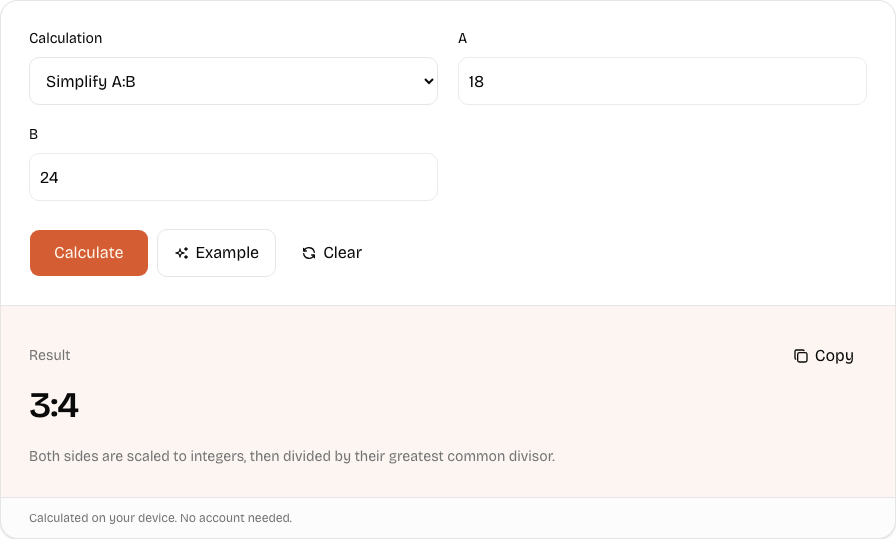
The ratio calculator can reduce the pair. Label what the first and second terms mean before entering them, especially when the ratio describes different ingredients or groups.
Match units before reducing
Compare 1.2 metres with 80 centimetres by converting the first quantity to 120 centimetres. The ratio is 120:80 = 3:2. Using the bare numbers 1.2:80 would compare quantities expressed in inconsistent units.
For a decimal pair such as 1.5:2.5, multiply both by 10 to get 15:25, then reduce to 3:5. Multiplying both terms by the same amount preserves the ratio.
Find a missing value with a proportion
Suppose 4:7 = 20:x. The first term grew by a factor of 5, so the second must also: x = 7 * 5 = 35. Cross multiplication gives the same result: 4x = 7 * 20, so x = 140 / 4 = 35.
Keep the order consistent. Swapping only one pair would create a different proportion. Check your answer by substituting it back: 20:35 reduces to 4:7.
Separate a part-to-part ratio from a share
A 3:4 mix has 7 equal parts altogether. The first ingredient's share is 3/7, approximately 42.8571%. It is not 3/4 of the mix. If the total amount is 350 units, one part is 350 / 7 = 50, giving amounts of 150 and 200.
FAQ
Can a simplified ratio contain zero?
One term can be zero in a meaningful comparison, such as 0:5 becoming 0:1. The pair 0:0 has no unique reduced relationship.
Does 3:4 mean the same as 4:3?
No. The order identifies which quantity is being compared with which.
Is a ratio always unitless?
A ratio of like measurements can cancel units after conversion. Comparisons such as distance per time retain a rate unit.
When simplifying ratios, preserve the order, align units and divide both terms together. When solving a proportion, substitute the missing term back into the original relationship as a check.
See OpenStax: ratios and rate for the distinction between ratios and rates.