
How to calculate age between two dates
Count completed calendar years, months and days, rather than dividing by 365. Understand Calcr’s leap-day and month-end convention.
By Calcr · Updated
To calculate calendar age, count completed years first, then completed months, then the remaining days. This keeps the result tied to calendar anniversaries rather than assuming every year and month has the same length.
Fix the comparison date
Age changes over time, so write down the date on which it is measured. A birth date of 2000-06-15 has a different age on 2026-06-14 and 2026-06-15. An explicit comparison date also makes an example reproducible.
Use the age calculator with invented dates if you are learning the method. The calculation does not need a name or other identifying details.
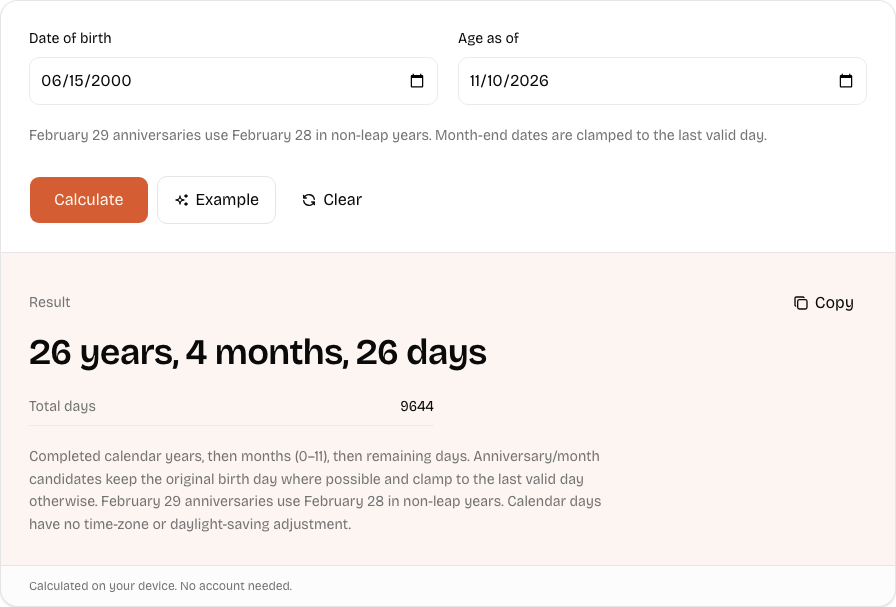
Count complete calendar units
For 2000-06-15 to 2026-11-10:
- Complete 26 years to reach 2026-06-15.
- Complete 4 further months to reach 2026-10-15.
- Count 26 remaining days to reach 2026-11-10.
The result is 26 years, 4 months and 26 days. For a birth date of 2010-11-11 measured on 2026-11-10, only 15 years are complete; the next anniversary is still one day away.
Understand leap days and month ends
The Gregorian leap-year rule adds February 29 in years divisible by 4, except century years not divisible by 400. Thus 2000 was a leap year and 2100 will not be.
Calcr uses a stated calculation convention: year and month candidates keep the original birth day when possible. If it does not exist in a destination month, that candidate is clamped to the month's last day. Later candidates remain anchored to the original birth day rather than to a previously clamped day. Under this convention, the non-leap-year anniversary of February 29 is February 28. Likewise, moving a January 31 date into February stops at February's last valid day.
This is a software convention, not a claim about legal birthdays, benefit eligibility or age restrictions. Those rules can depend on jurisdiction and context.
Why dividing days by 365 is different
A total-day count measures elapsed calendar days. Dividing it by 365 mixes leap days into a rough decimal-year figure, which can cross a whole-number threshold before the birthday. Use total days when that is the quantity needed and calendar units when the question concerns anniversaries.
FAQ
Can I measure a past or future age?
Yes. Choose the comparison date explicitly, provided it is not before the birth date.
Does the tool use time of birth?
No. It works with dates and does not calculate hours or time-zone offsets.
Is the displayed age verified?
No. It is computed from your inputs and cannot establish identity or prove eligibility.
For a reproducible age calculation, retain both dates and the month-end convention with the result.
The calendar rule is documented by the U.S. Naval Observatory: leap years. The anniversary convention above is Calcr's own stated behavior.