
How to count days between dates
Distinguish elapsed days from inclusive date counts. Work through leap days, reversed ranges and date addition without time-zone assumptions.
By Calcr · Updated
Before counting days between dates, decide whether you mean elapsed calendar days or the number of dates included in a range. The same start and end can correctly produce different answers when the counting rule changes.
Elapsed days measure the gap
From 2026-11-10 to 2026-11-13, three day boundaries pass: the 11th, 12th and 13th. The elapsed difference is 3 days. From a date to itself, no day has elapsed, so the difference is zero.
In the date calculator, leave inclusive end off to calculate this signed difference. If the end is before the start, the answer is negative; reversing the example produces -3.
Inclusive counting includes both boundaries
If you need to count the listed calendar dates, include November 10, 11, 12 and 13: four dates. For a forward range, this is elapsed difference + 1. A single-date range then counts as 1.
Calcr preserves direction for reversed ranges: the inclusive result for November 13 back to November 10 is -4. A negative count indicates direction, not a negative number of dates in the set. State the convention when sharing the result.
Check month and year boundaries
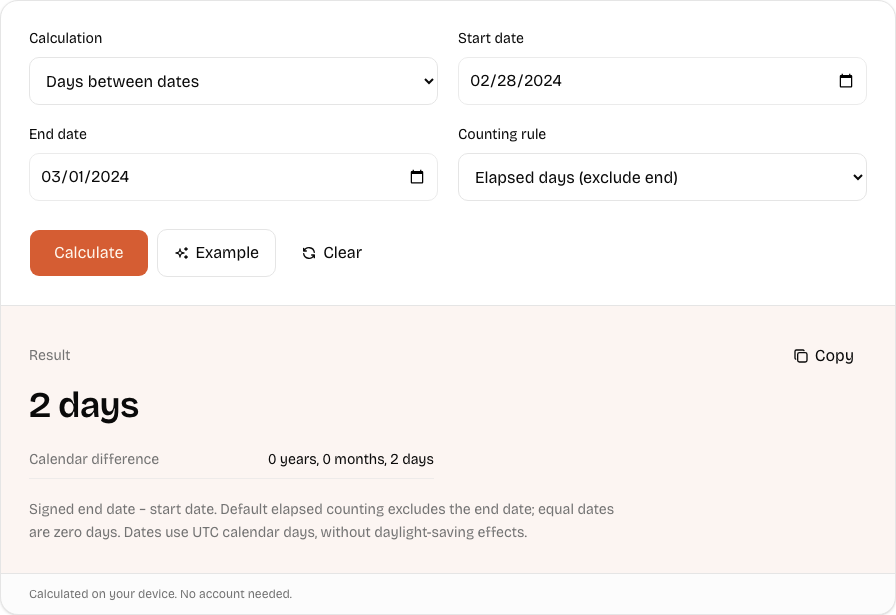
From 2024-02-28 to 2024-03-01 is 2 elapsed days because 2024 contains February 29. In 2025, February 28 to March 1 is only 1 elapsed day.
For date addition, 2026-12-31 plus 1 day becomes 2027-01-01. Subtracting 7 days from 2026-11-10 gives 2026-11-03. Use the add/subtract mode when you know the starting date and length rather than both boundary dates.
Calendar days are not business days or hours
Every date counts here, including weekends and public holidays. A contract may exclude particular days or set a local cutoff time; that requires rules beyond this calculator.
Likewise, a local day affected by a daylight-saving transition need not contain 24 elapsed hours. Calcr compares dates independently of a time zone. Use a time-zone-aware timestamp calculation for actual elapsed hours between two instants.
FAQ
Should I include the first day?
That depends on the task. Use elapsed difference for the gap and inclusive counting for a list containing both boundary dates.
Does the tool skip holidays?
No. It is a calendar-day calculator, not a regional business-day calendar.
Why is a leap-year February different?
It contains an additional valid date. The Gregorian rule determines which years include that date.
Label the counting rule with your result. A clear “3 elapsed calendar days” or “4 dates including both endpoints” is more useful than an unexplained number.
For calendar background, see the U.S. Naval Observatory's introduction to calendars. Calcr's inclusive and signed-range conventions are specified above.